King Crab Safari Tromso
See tours

About the crab

The king crab in Norway: where it came from and how big it gets

The king crab in Norway is a Pacific animal that arrived here in living memory. Soviet scientists released it into the Barents Sea between 1961 and 1969, it settled, it bred, and it has been walking west along the Norwegian coast ever since. Today the dense grounds reach as far west as Tromsø, which is why a king crab safari Tromso exists at all and why it stops here rather than further south.

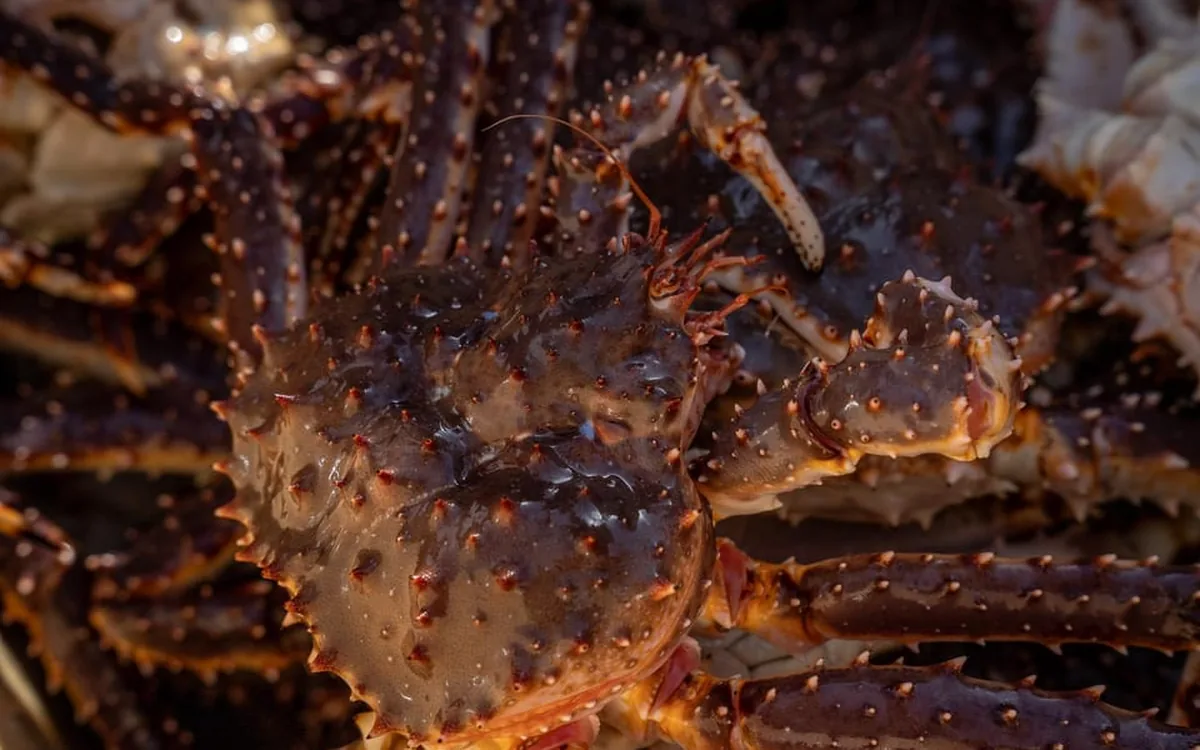
A king crab close up, shell and spines filling the frame

Quick answer

The red king crab in the Barents Sea is an introduced animal: released from the Pacific between 1961 and 1969, established by the 1970s, and spreading west along the coast ever since. It thrives in water of 2 to 8 °C, which is why the dense grounds end around Tromsø — south of here the sea runs warmer than the crab likes. A mature male spans more than a metre from claw tip to claw tip. Norway manages it as both a valuable fishery in the east and a species to be harvested freely in the west, and every trip on this page works inside those rules. Our top pick, $265, puts you on the rope and then on the plate.

The king crab in Norway, at a glance

Latin name
Paralithodes camtschaticusthe red king crab
Where it is from
The North PacificKamchatka, the Sea of Okhotsk, the Bering Sea
How it got here
Released 1961–1969into the Barents Sea, to build a fishery
Western edge of the dense grounds
Tromsøwarmer water lies to the south
Water it likes
2–8 °Crecorded from −1.6 to 18 °C
Leg span, mature male
Over a metreclaw tip to claw tip
Usual portion on a safari
One crab between twolegs and claws, freshly cooked
Safari season in Tromsø
All yearby boat, from quays in the town centre
Cheapest king crab safari here
$265four and a half hours, lunch ashore
Trips compared on this site
8six of them carry ratings

How it got here

A Pacific crab, a Soviet plan and sixty years of walking west

Released in the 1960s, established by the 1970s, in Norwegian fjords by the 1990s.

The story is short and unusually well documented. Between 1961 and 1969 Soviet marine biologists carried red king crabs from the North Pacific — Kamchatka, the Sea of Okhotsk — and released them into the Murman coast of the Barents Sea. The aim was a new commercial fishery in cold water where the species had never lived. It worked better than anyone expected.

By the 1970s the crab was reproducing on its own. By the 1990s it had crossed into Norwegian waters around Varangerfjord, the long inlet that Kirkenes sits on. From there it kept going: westward along Finnmark, past the North Cape, into the fjords of Troms. The king crab in Norway today is a self-sustaining population that arrived within the lifetime of the fishermen who now catch it.

That history explains something you will hear on the boat. The crew talk about the crab the way people talk about a newcomer who turned out to be useful: it is an introduced species, it changed the seabed it moved into, and it is also the most valuable thing many small boats in eastern Finnmark pull up all year. Both halves of that are true, and the guides say so plainly.

For a visitor it means one practical thing: this is a fishery you are allowed to take part in. Norway wants the crab harvested, and the tours that let you haul a pot yourself sit inside that policy rather than around the edge of it.

The western edge

Why Tromsø is the far end of the king crab range

Cold water to the east, milder water to the south, and Tromsø on the line.

Temperature is the thing that stops it. The red king crab is a cold-water animal: it does best between 2 and 8 °C, has been recorded from −1.6 up to 18 °C at different life stages, and larvae in particular are fussy. West and south of Tromsø the Gulf Stream keeps the coast milder, and the dense, commercially useful concentrations thin out.

So the map of the king crab in Norway runs roughly from the Russian border in the east to the waters around Tromsø in the west. Kirkenes sits in the middle of the strongest grounds — locals call it the king crab town and the fishery there is a real industry. Tromsø sits at the western end, where the crab is present in the fjords and a boat can reliably find it, but where the population is thinner than in Varanger.

This matters when you are choosing a trip. In Kirkenes the safari is built around an established commercial fishery: $279 takes a RIB out in summer, $369 runs a snowmobile sled across the frozen fjord in winter. In Tromsø the safari is built around a working boat going to pots its skipper set in fjords he knows — $265 and $361 both work that way, and both run from quays in the middle of town.

One is the heart of the range, the other is the edge of it. The crab on the plate at the end is the same animal.

King crab size

How big the animal actually is

The numbers that surprise people most when the pot comes over the rail.

  • Leg span

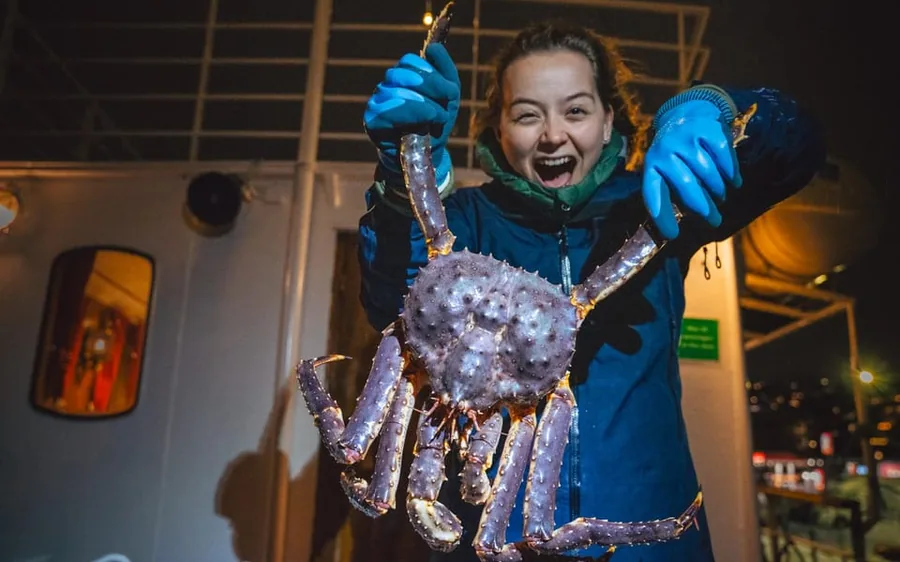
    A mature male spans more than a metre from claw tip to claw tip, and the biggest reach closer to a metre and a half. It is the span, rather than the body, that makes people step back when the first one lands on deck.

  • Weight

    Several kilos is normal for a keeper; the largest animals reach double figures. Lifting one with both hands is the photograph everybody takes, and it is heavier than it looks.

  • Carapace

    The body shell of a legal-size male is roughly the width of a dinner plate, covered in short spines. The spines are blunt enough to handle with the gloves the crew give you.

  • Legs

    Three pairs of walking legs and one pair of claws. The right claw is the heavy one, used for crushing; the left is finer. The walking legs hold the meat people remember.

  • Age

    A crab of legal size has been on the seabed for years, walking slowly across it and moulting its shell as it grows. That slow growth is part of why the fishery is managed.

Book direct

Four trips that put you next to one

Our top pick, the small-group hunt on the Senjafjell, the exclusive trap-setting trip and the Kirkenes RIB safari.

A guest holding a large king crab on deck in the evening light
Our top pick87 reviews
4.5 h

Tromsø: King crab cruise & self-captured lunch in restaurant

4.4 · 87 reviews

  • Four and a half hours, hunting Arctic king crabs aboard an explorer vessel
  • King crab lunch and fish soup
  • You haul the pots yourself
  • Free cancellation
$265$58.89 / hour
Check availability
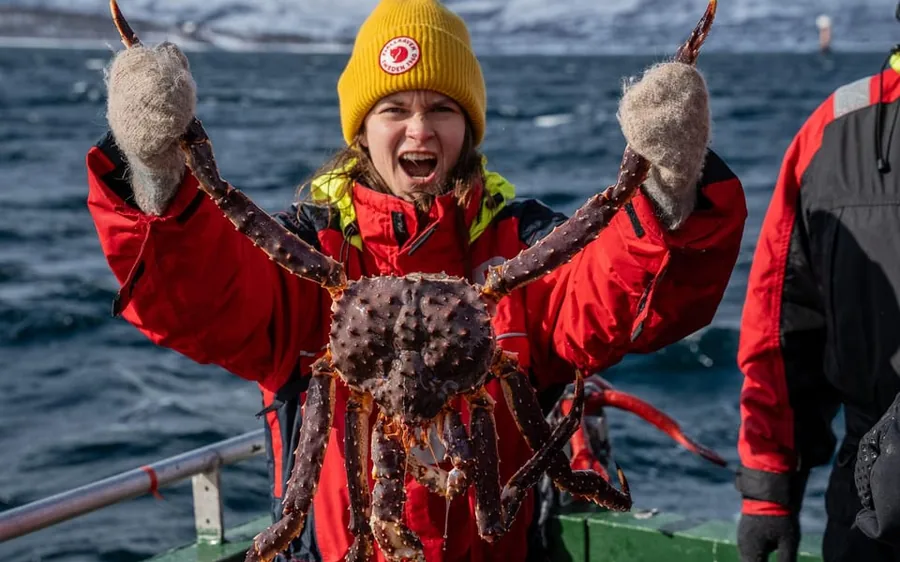
A guest in a yellow hat holding a king crab above her head
Rated 4.7Small group
3 h

The official Tromsø king crab fish tour

4.7 · 40 reviews

  • Three hours, the fjords of Tromsø aboard the Senjafjell
  • Hands-on Arctic crab hunt
  • Likely to sell out
  • Free cancellation
$361$120.33 / hour
Check availability
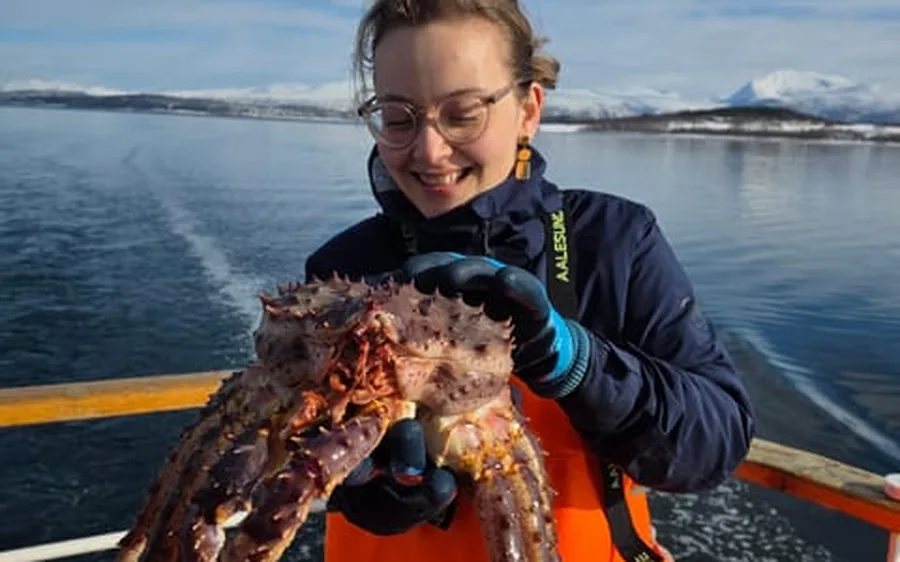
A guest holding a king crab with the fjord behind her
Small groupNew
3 h

Tromsø: Exclusive King Crab Fishing Experience

  • Three hours, an exclusive small-group crab hunt
  • You bait and set the traps
  • Fresh seafood served on board
  • Free cancellation
$310$103.33 / hour
Check availability
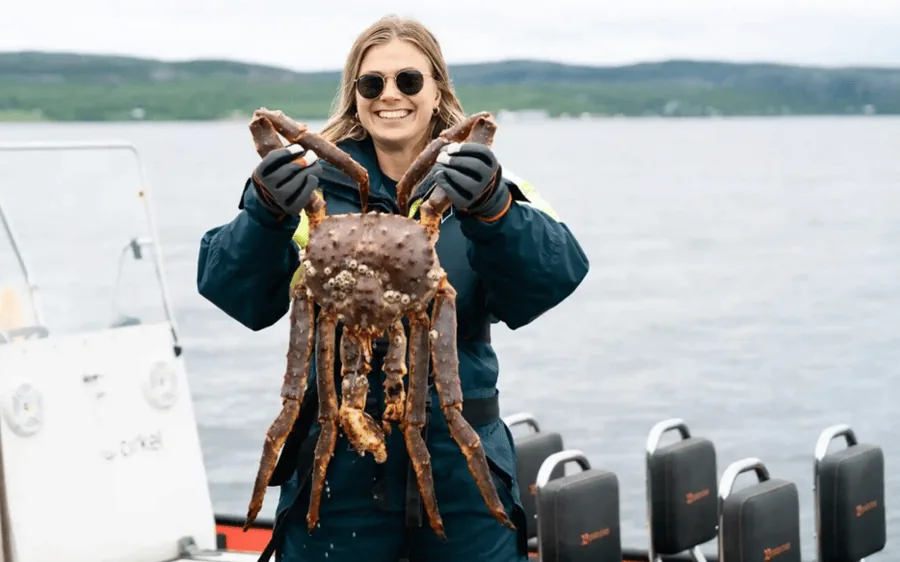
A guest holding a king crab aboard a RIB in summer
Rated 4.8By RIB
3 h

Kirkenes: Summer King Crab Safari by RIB with King Crab Meal

4.8 · 27 reviews

  • Three hours, catching and cooking king crab in Kirkenes
  • Cruise through the fjord
  • Freshly caught king crab meal
  • Free cancellation
$279$93.00 / hour
Check availability

The fishery

How Norway manages a crab it did not plan for

A quota fishery in the east, free harvest in the west, and you on the rope.

Norway runs the king crab as two different things at once, split by a line in the sea near the North Cape. East of it, in the Varanger grounds around Kirkenes, the crab is a managed commercial fishery with quotas, licensed boats and a very high price per kilo. The aim there is a stable, valuable stock.

West of that line, including the waters around Tromsø, the policy flips. Here the aim is to slow the spread, so the crab may be taken far more freely. That is the legal background to a king crab safari Tromso: the boat you go out on is harvesting an animal the state would rather see harvested.

For you this shows up in small ways. The crew will show you how they measure a crab and which ones go back over the side. They will tell you where the pots sat and for how long. On $265 and $310 you handle the rope and the trap yourself, which is legal precisely because of where you are on the map.

It also explains the price. King crab is one of the most valuable shellfish in the world, and a portion of it in a Tromsø restaurant costs real money on its own. When you compare $265 with a restaurant bill rather than with a sightseeing cruise, the arithmetic looks different.
Three things people get wrong

Corrections worth having before you board

All three come up in reviews of the king crab in Norway, every season.

  • That it is a Norwegian native

    It is a Pacific species that has been here since the 1960s. Norwegian, now, in every practical sense — it is caught, sold and eaten here — but it arrived by boat.

  • That the crab is fished from the open sea

    The pots sit in fjords, often within sight of land, on mud and sand bottoms at moderate depth. That is why a safari can be three hours long rather than three days.

  • That it is the same animal as the snow crab

    Snow crab is a smaller, deeper-water species also caught in the Barents Sea. The king crab is the big one with the spined shell and the metre-wide span, and it is the one on every trip here.

On the plate

What king crab tastes like, and why the boats cook it simply

Sweet, firm, boiled in sea water, served with butter and bread.

The meat is white, faintly sweet and firmer than brown crab, and it comes out of the leg in long clean pieces rather than in flakes. It needs very little: boiling in salted sea water, then butter, lemon and bread. Every boat on this page serves it close to that way, and the ones that add anything add a soup alongside rather than a sauce on top.

The usual portion on a safari is one crab between two people, which comes out as a plate of legs and claws each. It is generous without being a banquet, and it is the part of the day that reviews mention most. On $265 the eating happens ashore in a restaurant after the boat comes in; on $310 and $361 it happens on board while you are still out in the fjord.

If seafood beyond crab is what you are after, $174 is a fishing trip that cooks your own cod into a soup on deck, and it carries 743 reviews at 4.8 — more than any other trip on this site. It is a different day, and it is covered on its own page.

Haul the pots yourself in a Tromsø fjord, then eat your own catch in a restaurant ashore. 87 reviews at 4.4, four and a half hours, from $265.

Check dates for our top pick

Common questions

Questions about the king crab in Norway

Why are king crabs in Norway?

They were released into the Barents Sea from the North Pacific between 1961 and 1969 to create a fishery, established themselves, and have been spreading west along the Norwegian coast ever since.

How far west do king crabs go?

The dense grounds reach the waters around Tromsø. South of that the sea is warmer than the species prefers, so the population thins out.

How big is a king crab?

A mature male spans more than a metre from claw tip to claw tip and weighs several kilos; the largest reach double figures.

Is the king crab protected in Norway?

It is managed. East of the North Cape it is a quota fishery with licensed boats; west of that line, including Tromsø, it may be harvested far more freely to slow its spread.

Can you catch one yourself on a tour?

Yes. On $265 and $310 guests handle the rope and the trap with the crew, and on $369 you pull your own pot through the ice.

What does king crab taste like?

White, firm, faintly sweet meat that comes out of the leg in long pieces. The boats boil it in salted water and serve it with butter, lemon and bread.

In short

The king crab in Norway, in four lines

An incomer, at the edge of its range, big, and legal to catch.

It is an incomer. Released into the Barents Sea in the 1960s, established by the 1970s, in Norwegian fjords from the 1990s.

Tromsø is the western edge. The crab likes 2 to 8 °C; the coast south of here is warmer, so this is where the dense grounds end.

It is big. Over a metre across the legs, several kilos in the hand, and one animal feeds two people.

You are allowed to help. West of the North Cape the policy is harvest, which is why a king crab safari Tromso can hand you the rope instead of a viewing platform.

Go deeper

More on king crab safaris

Tromsø: King crab cruise & self-captured lunch in restaurant

4.4 · 87 reviews · Free cancellation 24 h

$265our top pick Check dates